x402 V2 Released: What Are the Core Highlights?

marsbitPublished on 2025-12-12Last updated on 2025-12-12

Abstract

The x402 protocol, initially developed by Coinbase, has now released its V2 upgrade. The core idea remains leveraging the HTTP 402 status code to embed payment logic directly into web requests. Since its launch, x402 has processed over 100 million payments across various use cases, such as API calls and AI agents purchasing compute resources. V2 introduces several major improvements. It supports wallet-based identity (e.g., Sign-In-With-X via CAIP-122) and reusable sessions, allowing users and autonomous agents to avoid repeated on-chain payments after initial authentication, significantly reducing latency and cost for high-frequency interactions. A unified payment interface now supports multiple chains (including Base and Solana) by default and integrates traditional payment rails like ACH and credit cards through Facilitators. Dynamic payTo routing enables complex pricing models and multi-tenant setups. The architecture is now modular and plugin-based, making it easier for developers to extend support for new chains or payment methods without altering core SDK code. Configuration is simplified, with automatic optimization based on developer preferences. A new discovery mechanism allows services to publish structured metadata, which Facilitators can automatically index, ensuring pricing and endpoint information stays current without manual updates. For end-users, V2 enables seamless, near-invisible payments with a "micro-subscription" feel. Developers benefit from reduc...

When the x402 protocol, led by Coinbase, was launched in May of this year, its core concept was surprisingly simple: reactivate the long-dormant HTTP 402 status code, embedding payment logic directly within network requests.

Although the performance of x402-related tokens was short-lived, over the past 6 months, x402 has already processed over 100 million payments, covering diverse scenarios such as API paid calls and AI agents purchasing computing resources on demand.

While the V1 architecture was simple, it revealed some limitations in practical use. Particularly in areas like cross-chain support, scalability, identity authentication, and duplicate payments, the original design could not meet the increasingly complex payment demands.

Today, x402 has ushered in the V2 version upgrade. This update not only optimizes the protocol itself but also involves a deep-level restructuring around issues identified during actual use.

What Are the Core Highlights of x402?

Wallet Identity Integration and "Reusable Sessions": Say Goodbye to Duplicate Payments

This is the most significant change in V2 for enhancing user and agent experience. In V1, each API call might require a complete payment process, which resulted in high latency and costs in high-frequency scenarios (such as large language model LLM inference and multi-step agent tasks).

x402 V2 introduces support for wallet identities (such as Sign-In-With-X based on CAIP-122). Once the client verifies their identity via a wallet and completes the initial payment, the protocol allows the creation of reusable sessions. This means subsequent repeated access to the same resource can skip the full on-chain payment process.

This significantly reduces transaction latency, minimizes round-trips, and lowers on-chain costs, making x402 truly suitable for high-frequency workloads. It provides a subscription-like or session-based access model for human users and autonomous agents.

Unified Payment Interface: Integration of Cross-Chain and Traditional Finance

x402 V2 creates a one-stop payment format, regardless of which chain the asset is on, or even if it is on-chain.

· Default Multi-Chain Support: The protocol natively supports stablecoins and tokens on Base, Solana, and other L2s, eliminating the need for developers to customize logic.

· Compatible with Traditional Payments: Through Facilitators, V2 can be compatible with traditional payment rails like ACH, SEPA, or credit card networks.

· Dynamic payTo Routing: Allows request-level payment routing, such as directing payments to specific addresses, roles, or callback logic, adapting to complex marketplaces and multi-tenant APIs, and enabling dynamic pricing based on input content.

Plugin Architecture and Developer-Friendly Extensibility

x402 V2 modularizes the protocol, creating a clear separation between the protocol specification, SDK implementation, and Facilitators.

· Stable and Extensible: Adding a new chain or payment method does not require modifying the core specification or reference SDK.

· Plugin-Driven SDK: Developers can register new chains, assets, and payment schemes like installing plugins, rather than modifying the SDK's internal code.

· Simplified Configuration: V2 significantly simplifies the developer configuration process while natively supporting Multi-Facilitator. The SDK will automatically select the best matching option based on business preferences (e.g., "Prefer Solana," "Avoid Mainnet," use only "USDC").

Automatic Discovery Mechanism: Keeping Service Information Synchronized

x402 V2 introduces a "Discovery" extension, allowing x402-enabled services to expose structured metadata for Facilitators to crawl.

· Zero-Intervention Synchronization: Service pricing, routing, and metadata can be updated automatically. Facilitators can index available endpoints automatically, eliminating the need for manual updates or hardcoded directories.

· Enhanced Autonomy: Sellers only need to publish their API once, and the entire ecosystem remains synchronized, laying the foundation for a more autonomous internet economy.

Perspectives of Different Participants

The upgrade of x402 V2 transforms payment from a technical friction point into an economic layer, essentially making the flow of value on the internet smoother and smarter. For different participants, this means solving their respective most pressing problems.

For end-users, the core value of x402 V2 lies in seamless payment and efficiency improvement, making paid access to services more like logging in and using, significantly reducing the cost and latency of repeated access. The first access requires completing the payment, but subsequent repeated use of the service within the same session or time period (such as multiple AI calls or accessing paid content) does not require additional on-chain payments if resources have already been purchased, resulting in faster speed and lower cost. It feels like a "micro-subscription." Simultaneously, payment methods become more diverse and convenient.

Furthermore, since Facilitators can automatically obtain the latest pricing and service information, it ensures users see accurate and available prices and services, avoiding information lag issues. For users, it also becomes easier to find and use services.

For developers and service providers, V2 addresses the architectural and scalability pain points of V1, bringing higher flexibility and lower code maintenance burden. For example, payment logic changes from "hardcoded" to "configuration and plugins"; dynamic pricing can be implemented based on the input content of API requests (such as the amount of data processed, model size), easily enabling complex business models; since the payment wall logic is extracted into an independent, customizable modular package, developers can more easily integrate different payment backends and quickly build and iterate their paid services. Additionally, simply declaring business preferences allows the SDK to automatically select the optimal payment path and coordinator. This reduces a significant amount of "glue code," allowing developers to focus on business logic.

For AI agents, the improvements in V2 are revolutionary, transforming AI from a pure "executor" into an autonomous "economic agent." An AI agent can be assigned a wallet with a budget. When it needs to call an API to complete a task or rent more powerful computing resources to run a model, it can "decide for itself" and complete the payment, and can dynamically search the network for the most cost-effective resources.

Summary

The release of x402 V2 marks the evolution of x402 from a "pay-per-use" tool to a flexible, universal economic layer. For users, payments become almost invisible, enhancing the experience. For developers, the architecture is more flexible, enabling rapid building and iteration of complex business models. And AI agents can achieve low-latency, high-frequency autonomous consumption, unlocking more advanced autonomous systems.

By expanding compatibility, simplifying development processes, and enabling innovative identity and payment models, x402 is building the infrastructure for the future of internet payments. However, any technology that brings innovation will inevitably face challenges and inherent shortcomings. Although x402 V2 paints a promising blueprint, to realize it, many practical obstacles must be overcome, such as ecosystem adoption and maturity, risks of "modules," challenges of refunds and dispute resolution, regulatory uncertainty, and more.

Related Questions

QWhat is the core innovation of the x402 V2 protocol?

AThe core innovation of x402 V2 is its evolution into a flexible, universal economic layer for the internet. It reactivates the HTTP 402 status code to embed payment logic directly into web requests, and V2 specifically enhances this with features like identity-based reusable sessions, a unified multi-chain payment interface, and a plugin-based architecture.

QHow does the 'Reusable Sessions' feature in x402 V2 improve the user experience?

AThe 'Reusable Sessions' feature allows a client to verify their identity (e.g., via Sign-In-With-X) and complete an initial payment. Subsequent requests within the same session can then skip the full on-chain payment process, significantly reducing transaction latency, costs, and the number of round trips. This creates a subscription-like or session-based access model ideal for high-frequency workloads.

QWhat does the 'Unified Payment Interface' in V2 enable for developers?

AThe 'Unified Payment Interface' provides a one-stop payment format that supports multiple blockchains (like Base and Solana) by default and is compatible with traditional payment rails (like ACH, SEPA, or credit cards) through Facilitators. It also allows for dynamic 'payTo' routing, enabling complex pricing models and payments to specific addresses or roles based on the request.

QWhat is the 'Plugin-driven SDK' and how does it benefit developers?

AThe 'Plugin-driven SDK' is a module where developers can register new chains, assets, and payment methods as plugins without modifying the core SDK code. This plugin-based approach simplifies configuration, reduces maintenance burden, and allows the SDK to automatically select the best payment path based on developer-defined business preferences.

QHow does the 'Discovery' extension in V2 improve the ecosystem?

AThe 'Discovery' extension allows x402-enabled services to expose structured metadata for Facilitators to automatically scrape. This enables zero-intervention synchronization of service pricing, routing, and metadata. Facilitators can automatically index available endpoints without manual updates, making it easier for users to find services and for the entire ecosystem to stay current.

Related Reads

From Airdrop Myth to King of Derivatives: A Look Back at Hyperliquid's 2025 Conquest

Reviewing crypto's growth in 2025, Hyperliquid stands out. It began the year with an epic airdrop and strong price performance, capturing attention. By year's end, it transformed into a top-four revenue-generating platform in crypto, earning over $650M and at one point capturing 70% of all perp trading volume. Its success was no accident. In Q1, it solidified its reputation by being first to list new assets like the TRUMP perp and launched HyperEVM, a smart contract layer. Q2 saw explosive growth: HYPE token surged 4x from April lows, and HyperEVM's TVL grew from $350M to $1.8B. The platform gained mainstream media coverage. In Q3, major wallets like Phantom and MetaMask integrated via Hyperliquid's builder codes, routing $158B in volume and earning partners nearly $50M. A high-profile stablecoin bid war was won by Native Markets, aligning with Hyperliquid's bootstrapped ethos. However, new competitors like Aster and Lighter emerged with aggressive airdrops. Q4 brought permissionless listings via HIP-3, enabling new markets like stock perps and yield-bearing collateral. Yet, HYPE fell nearly 50% from its September peak due to market conditions, a rare ADL event during a crash, and the start of team token unlocks. As perps go mainstream in 2026, Hyperliquid's true test begins. Its success came from building a superior product and ecosystem without shortcuts. Maintaining leadership will require doing it all over again in a crowded field.

marsbitHace 6 min(s)

From Airdrop Myth to King of Derivatives: A Look Back at Hyperliquid's 2025 Conquest

marsbitHace 6 min(s)

ETC Olympia Development Part 1: Implementing ECIP-1111 and ECIP-1112

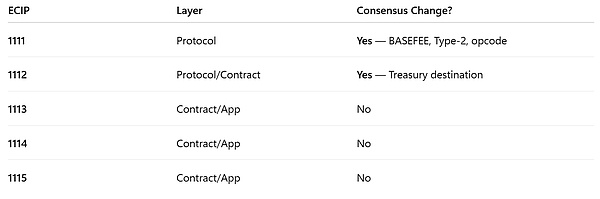
ETC Olympia Development Series Part 1: Implementing ECIP-1111 and ECIP-1112 This article introduces the first part of the Ethereum Classic Olympia development series, focusing on the implementation of ECIP-1111 and ECIP-1112. These two proposals are the only components within the broader Olympia framework that modify consensus behavior. ECIP-1111 modernizes the fee market by introducing an EIP-1559-style mechanism with a base fee and optional priority tip (miner tip). A key difference from Ethereum is that the base fee is not burned but is instead redirected to a treasury address defined by ECIP-1112. It also adds support for Type-2 transactions and the BASEFEE opcode (0x48), ensuring compatibility with modern EVM tooling and wallets. Crucially, it does not change miner rewards, monetary policy, or existing transaction types. ECIP-1112 defines an immutable, deterministic treasury smart contract that will receive the redirected base fees. This vault is designed to be receive-only upon activation, meaning it can accumulate value but cannot distribute funds until a separate, subsequent governance layer (defined in other ECIPs) is deployed and activated on the contract layer. The article emphasizes the modular architecture of Olympia. While the suite includes five ECIPs (1111-1115), only these two affect consensus. This separation ensures that the core protocol remains minimal and auditable, while future governance and funding mechanisms can evolve independently at the contract level without requiring further hard forks. The implementation is currently in the draft stage per the ECIP-1000 process. Any decision to move forward with mainnet activation will require extensive testing on the Mordor testnet and full community review.

金色财经Hace 10 min(s)

ETC Olympia Development Part 1: Implementing ECIP-1111 and ECIP-1112

金色财经Hace 10 min(s)

Market Divergence: SOL Becomes Institutional Darling, Terra Ecosystem Completely Collapses, ZEC Shorts Forced to 'Hold the Bag' by Whales?

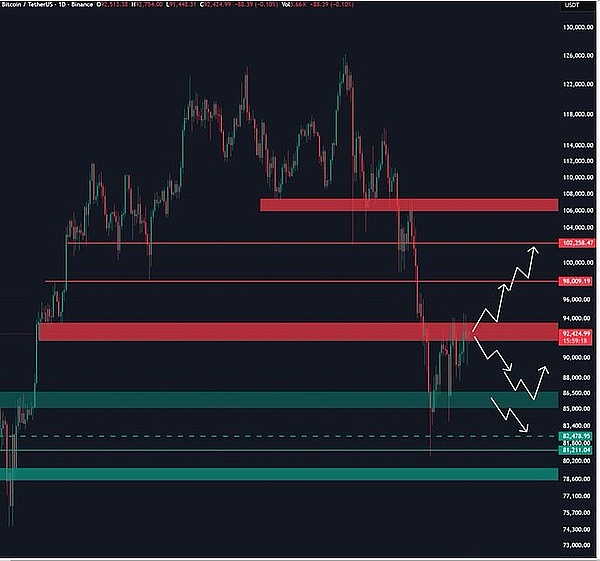
The cryptocurrency market is currently experiencing significant divergence, with some assets surging while others face severe downturns. Bitcoin (BTC) is testing a critical resistance zone between $92,000 and $94,000. A successful breakout could propel it toward $100,000, while failure may lead to a pullback below $90,000. Similarly, Ethereum (ETH) is approaching its key level at $3,400. Holding above this could push it to $3,700-$3,800, otherwise a retest of $3,000 support is likely. Solana (SOL) has emerged as a major institutional favorite. Despite market volatility, SOL ETFs continue seeing consistent inflows. Support from major platforms like Coinbase, which integrated Solana DEX functionality, and growing adoption by traditional finance giants like JPMorgan and Nasdaq, highlight strong fundamental strength. Accumulating SOL gradually is recommended. In contrast, the Terra ecosystem (LUNA, LUNC, USTC) has effectively collapsed. Founder Do Kwon received a 15-year prison sentence, and the project's $40 billion collapse triggered a broader market crisis. These assets are considered uninvestable. Zcash (ZEC) presents a cautionary tale for short sellers. Many are trapped in losing positions as large holders (whales) maintain price range, collecting funding rates systematically. This strategy allows whales to profit from perpetual funding while gradually squeezing shorts. The lesson: take profits quickly when shorting ZEC and avoid greed. Overall strategy: Wait for BTC/ETH to break key levels before acting, accumulate SOL steadily, avoid Terra assets entirely, and short ZEC with extreme caution.

金色财经Hace 11 min(s)

Market Divergence: SOL Becomes Institutional Darling, Terra Ecosystem Completely Collapses, ZEC Shorts Forced to 'Hold the Bag' by Whales?

金色财经Hace 11 min(s)

Trading

Spot
Futures
活动图片